H3 Max, Wan 3.0 and GPT Image 2.5: one puddle, five video models
ChatPlus adds two video models, the lightning-fast H3 Max and the true-to-life Wan 3.0, and GPT Image 2.5 replaces GPT Image 2. We gave all five video models the same prompt and timed them: from eleven seconds to almost four minutes. Here is how each one did and what it costs.
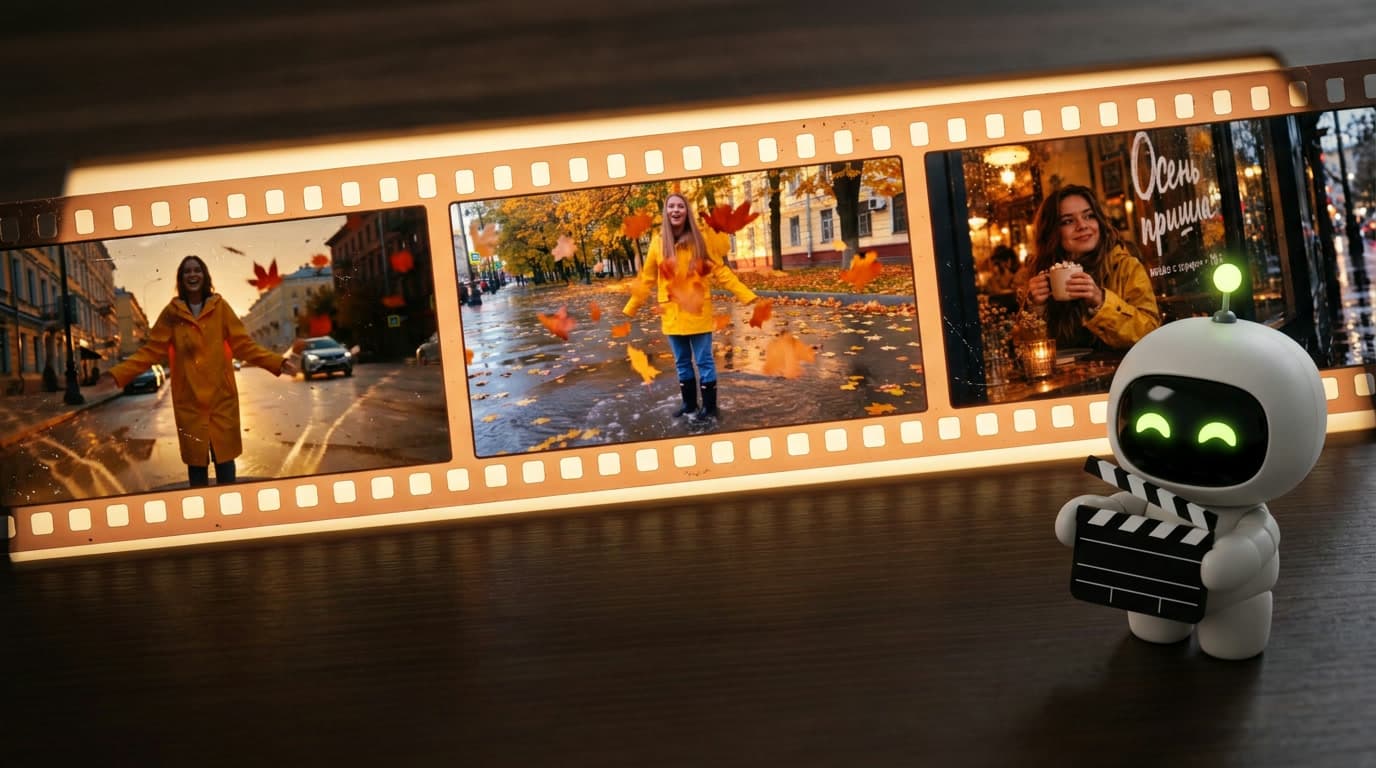
Comparing video models by their launch posts gets you nowhere: every one of them is "the most realistic" and "best in class". So we did something simpler. We took one prompt, sent it to all five video models on ChatPlus, and timed how long each took and what came back.
The prompt: "An autumn street after the rain, golden hour. A young woman in a yellow raincoat jumps into a puddle, water splashes, maple leaves swirl around her. She laughs and says: 'Autumn is here!' Handheld camera, natural street sound."
Two of the five models are new on ChatPlus: H3 Max and Wan 3.0. We also updated the default image model, so GPT Image 2.5 now runs where GPT Image 2 used to. Let's go through them one by one, and at the end, which to pick when.
H3 Max: a clip before your coffee cools
Start with the number that makes this model worth a try. Eleven seconds. That is how long it took from pressing the button to a finished five-second clip with sound, including the queue and the file download. The generation itself takes only a few seconds on the GPU. The other models needed anywhere from just under a minute to almost four minutes for the same prompt.
Where the speed comes from: the base is MiniMax H3, an open-weights video model from the Chinese company MiniMax. The team at fal, one of the biggest platforms for running generative models, post-trained it and rebuilt it for their own servers. They released the result as H3 Max at the end of August. By their measurements, throughput went up roughly 35 times compared with the original H3, and in blind comparisons, where viewers choose the better of two clips without knowing which model made which, H3 Max beat a dozen competitors.
Speed is not the only upside. H3 Max always generates sound: street noise, footsteps, laughter, short lines of dialogue. In our test the woman jumped into the puddle, the leaves spun around her, and the line from the prompt came through clearly. There is no sound switch, and there doesn't need to be one, because the audio costs nothing extra.
H3 Max, 11 seconds from request to file. Turn the sound on for the line at the end.
Now the honest limits. Resolution is 768p, below Full HD. That is plenty for stories, reels and drafts, not for a big screen. And in complex scenes with fast motion, H3 Max is simpler than the expensive models: details are a little softer and the water physics more modest.
The price makes up for it: 40 media credits per second, so a five-second clip is 200 credits. That is the cheapest video on ChatPlus. Our way to use it: try five or ten versions of a prompt, find the idea that works, and then, if you want, send the final version to a pricier model.
Wan 3.0: video that looks shot on a phone
Wan is Alibaba's family of video models. The third generation went into beta in early August 2026 and became available to everyone on August 24. Alibaba focused on people: lifelike faces of all kinds, natural expressions, movement without the plastic look many AI models have.
The model can do more than we use today. Natively it generates clips up to 30 seconds long and accepts text, images, audio and even video as input. On ChatPlus you can make 5, 10 or 15-second clips in 720p, from a description or from your own photo.
In our test, Wan made the most everyday-looking clip of the five. No advertising gloss: an ordinary street, rubber boots, leaves flying straight at the lens. It looks most like a video a friend shot on her phone, which is exactly what "handheld camera" asked for. Sound and the spoken line are both there.
Wan 3.0, 2 minutes 37 seconds. The most phone-like footage of the five.
We waited over two and a half minutes. That is normal for video models at this level, but after H3 Max it feels like forever.
On price, Wan 3.0 sits in the middle: 50 media credits per second, and sound doesn't change the cost. A five-second clip is 250 credits. Kling 3 Pro with sound costs 420 and Seedance Pro 760. If you need a believable person on screen without overpaying, start with Wan.
One prompt, five models
Here is how all five did. Time is from request to finished file, price is for a clip of that length with sound.
| Model | Time | Length | Price, credits |
|---|---|---|---|
| H3 Max | 11 s | 5 s | 200 |
| Veo 3.1 | 54 s | 6 s | 1,200 (Fast: 456) |
| Kling 3 Pro | 1 min 46 s | 5 s | 420 |
| Wan 3.0 | 2 min 37 s | 5 s | 250 |
| Seedance Pro | 3 min 54 s | 5 s | 760 |
Veo 3.1 from Google delivered the most cinematic shot: the sun straight into the lens, a carpet of red leaves along the curb, a big splash, all straight out of a commercial. Veo's sound is the best of the bunch, a mixed soundtrack rather than noise layered on top. It is also the most expensive second on ChatPlus. For drafts there is Veo 3.1 Fast: quicker and much cheaper.
Veo 3.1, 54 seconds. Backlight and colour like a commercial.
Kling 3 Pro took its own approach. For the whole clip the camera stayed on her feet and the splashes; we heard the line but never saw her face. The model didn't get it wrong, it just read "jumps into a puddle" literally. Kling's real strength is elsewhere, in bringing photos to life, more on that below.
Kling 3 Pro, 1 minute 46 seconds. Boots, splashes and reflections, but no face.
Seedance Pro from ByteDance took the longest and showed the most careful handling of motion. Clean sheets of water flying off the puddle, leaves caught mid-air, and a camera that moves from a wide shot right up to her laughing face, as if a camera operator were running alongside.
Seedance Pro, 3 minutes 54 seconds. From a wide shot to a close-up in one take.
The takeaway: there is no single "best" model. Each has its own character, and the right one depends on the job.
GPT Image 2.5 replaces GPT Image 2
Now images. On September 8, OpenAI released GPT Image 2.5 in two versions. Sunburst is the precise one: it follows the prompt more closely and is better at editing existing pictures. Flare is the faster, simpler one. ChatPlus runs Sunburst.
GPT Image 2 was already our default because it is so good at text inside pictures. Version 2.5 is even neater with lettering and holds on to long prompts packed with details. We tested it on the same autumn theme: the woman in the yellow raincoat at a café table with a cup of cocoa, plus hand-lettered text on the window. Just over half a minute later we had the picture, with a handwritten headline on the glass and a small price line underneath, and not a single broken letter. It even added a menu board in the back on its own, and that came out clean too.
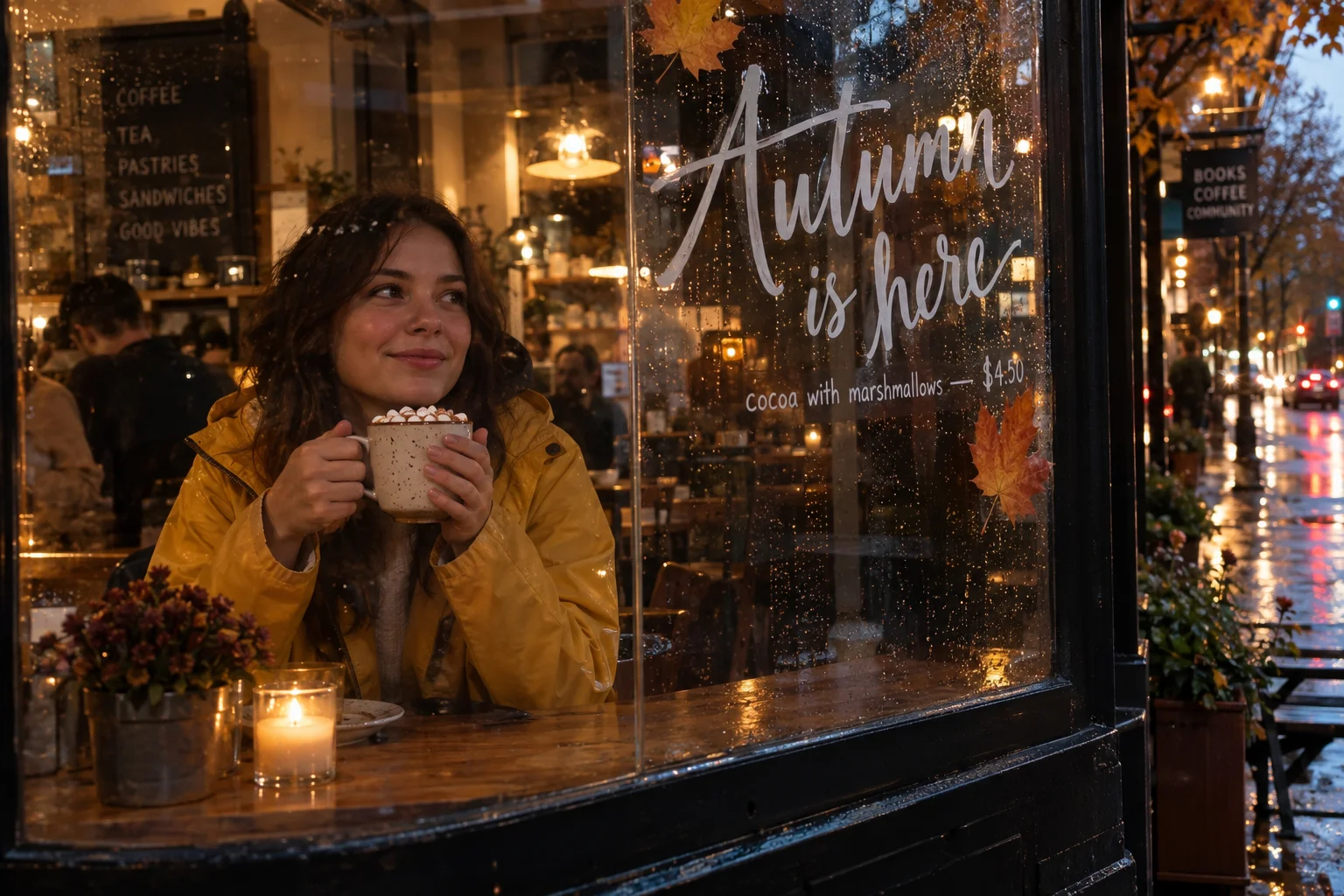
GPT Image 2.5, 36 seconds. Both lines on the glass came out right first time.
Edits are more reliable too. Upload a photo and say what to change: the model changes what you asked for and is less likely to redraw anything else.
Prices are unchanged: 10 media credits per picture at standard quality and 50 at high. If you had GPT Image 2 selected, there is nothing to do: the generator has switched to 2.5 on its own. Try GPT Image 2.5.
Picture first, then video
The most interesting result of the test happened by accident. We took that café picture from GPT Image 2.5 and gave it to Kling 3 Pro to animate. Steam rose from the cocoa, drops ran down the glass, the woman smiled. And the lettering on the window didn't warp in a single frame, even though text is usually the first thing video models break.
Picture by GPT Image 2.5, motion by Kling 3 Pro.
That gives you a reliable recipe for covers, cards and social clips. First draw the perfect frame in GPT Image 2.5: cheap, and with the text right. Then bring it to life in Kling 3 Pro or Wan 3.0. It is far more predictable than describing the whole scene in words and hoping the video model arranges everything correctly.
One caveat. Seedance Pro won't animate photos of real people, because ByteDance blocks them. For portraits and family photos use Kling 3 Pro: it keeps the face recognisable from the first second to the last.
Which model to pick
In short, it depends on the job.
Fast and cheap — testing an idea, making a story, trying prompt variations — H3 Max. Around ten seconds and 200 credits per try.
A real-looking person in an everyday, non-advertising shot — Wan 3.0. Sound included, mid-range price.
Bringing your own photo to life — Kling 3 Pro. Faces, clothes and lettering stay as they were in the shot.
A cinematic clip with film-quality sound — Veo 3.1, and Veo 3.1 Fast for drafts.
Complex motion — dance, sport, water, shot changes — Seedance Pro, if you are happy to wait and pay more.
You can switch models right in the video generator, for example starting with H3 Max. Video and images draw on the same media credits, and the price of a clip is shown before you start.
In short
ChatPlus has two new video models. H3 Max is fal's accelerated version of MiniMax H3: a clip with sound in about ten seconds, 200 media credits for five seconds, 768p. Wan 3.0 from Alibaba brings lifelike people and natural motion, with sound included in the price, 250 credits for five seconds. The default image model is now GPT Image 2.5 from OpenAI: neater with text and edits, same prices of 10 and 50 credits. In our one-prompt test, H3 Max was the fastest, Veo 3.1 the most cinematic, and Seedance Pro the most careful with motion.